The 108 Sacred Names of Lord Vishnu: [Sanskrit Mantras & English Meanings] Significance of the Om Namo Bhagavate Vasudevaya Mahamantra and Daily Chanting Benefits
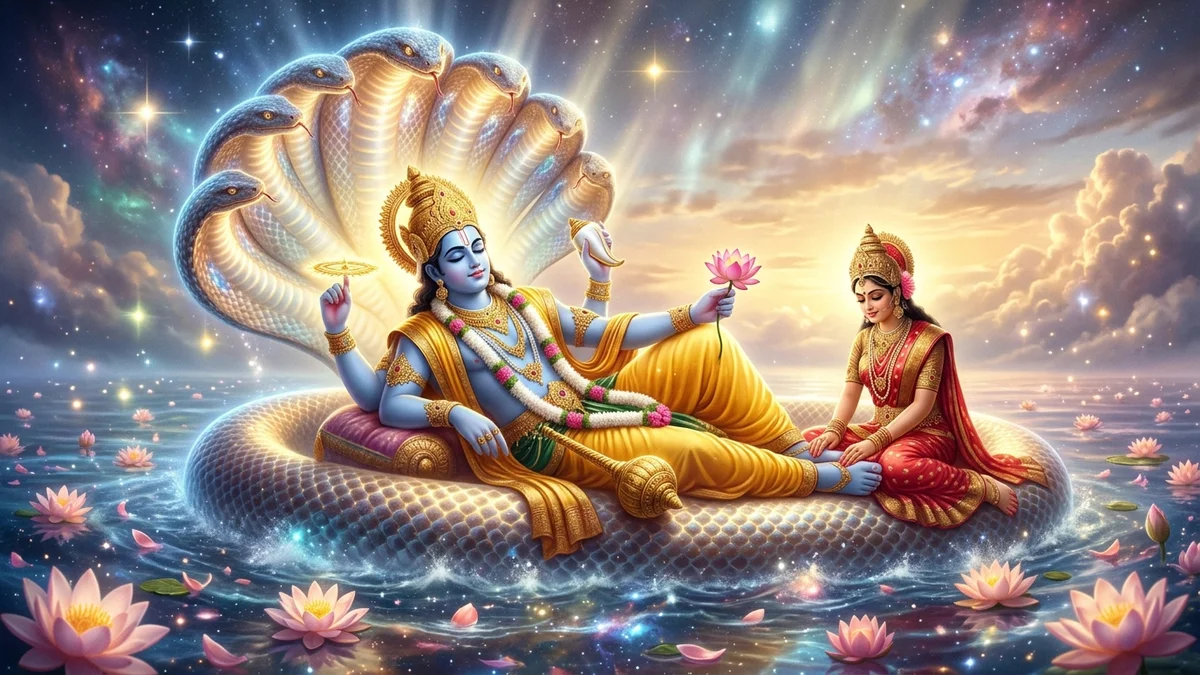 AI-generated illustration
KEY HIGHLIGHTS
Discover the 108 sacred names of Lord Vishnu (Ashtottara Shatanam), complete with their divine Sanskrit mantras and simple meanings. Explore the profound spiritual significance of the twelve-syllable Dwadashakshara mantra, "Om Namo Bhagavate Vasudevaya," including its five miraculous benefits and the essential rituals for daily chanting to invite divine grace into your life.
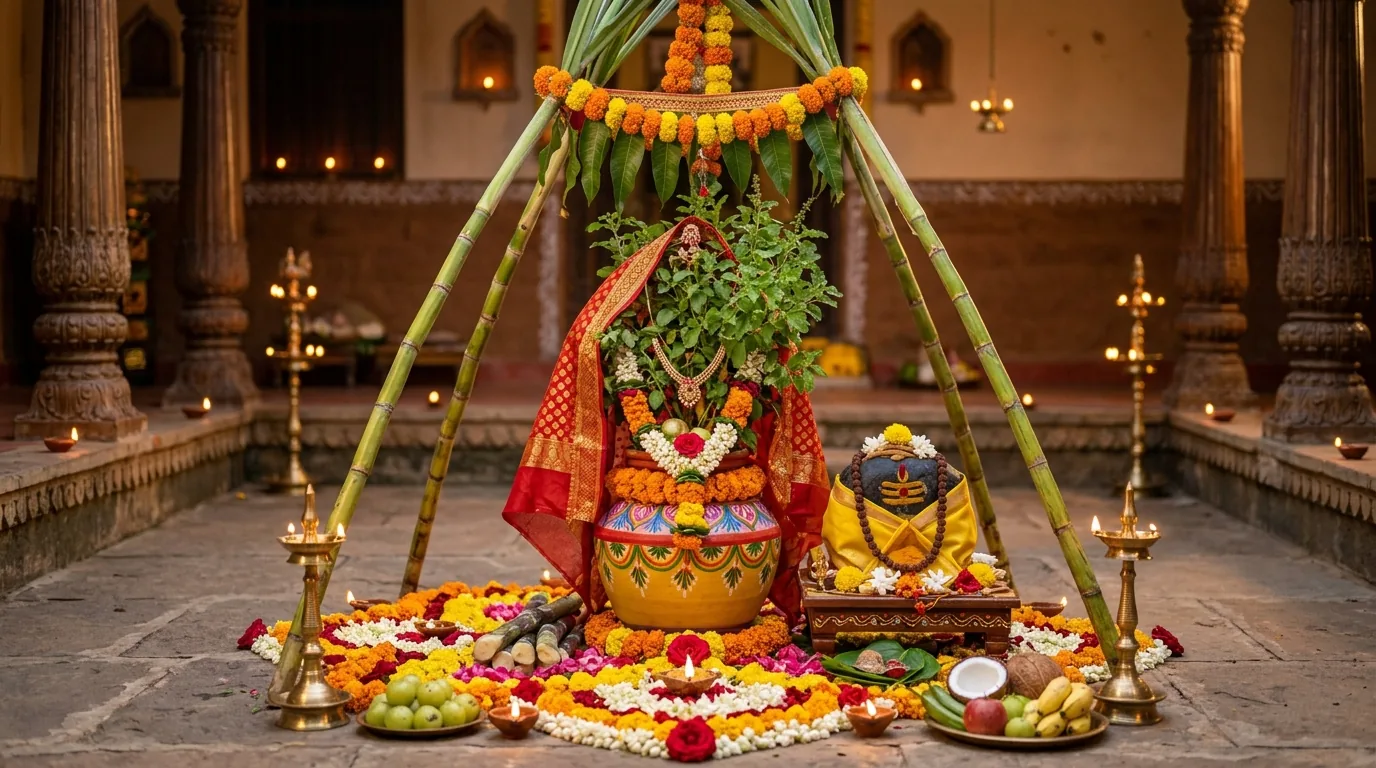
Whether it is the observance of the 24 Ekadashis throughout the year, special Thursday worship, or the upcoming auspicious festivals of Devutthana Ekadashi and Tulsi Vivah, this list of 108 names and the great mantra 'Om Namo Bhagavate Vasudevaya' form the most auspicious foundation for daily devotion. Let us explore the Sanskrit mantras of Lord Vishnu's 108 names, their simple English meanings, and the guidelines for chanting.
Table of Contents
Quick Summary: The Significance of Chanting Lord Vishnu's Names and Mantras
Reciting these 108 names of Lord Vishnu yields merit equivalent to reciting the 1,000 names (Vishnu Sahasranama) and helps alleviate life's difficulties.
This is a miraculous 12-syllable mantra. Chanting it 108 times daily keeps the mind calm and ensures the grace of Lord Vishnu.
It is considered most auspicious to chant using a Tulsi mala (rosary), facing East or North, while sitting on a yellow mat.
The 12-Syllable Mahamantra: The Supernatural Power of Om Namo Bhagavate Vasudevaya
In the Srimad Bhagavatam and the Vishnu Purana, 'Om Namo Bhagavate Vasudevaya' is declared the supreme mantra for liberation and devotion. It consists of 12 syllables (Dwadash Akshar). Scriptures suggest that this mantra balances the 12 zodiac signs, the 12 months of the year, and the 12 solar forms of the Sun:
॥ Om Namo Bhagavate Vasudevaya ॥
Meaning of the Mantra: "We offer our repeated salutations to the omnipresent, unborn, blissful Lord Vasudeva (Shri Krishna/Vishnu), the master of all living and non-living beings."
5 Direct Miraculous Benefits of Chanting This Mahamantra:
The vibration of the 12 syllables calms brain waves, effectively erasing anxiety, fear, and negative thoughts.
If Jupiter (Guru) is weak in your horoscope, chanting one mala of this mantra daily brings wisdom, wealth, and stability to married life.
In a household where this mantra resonates daily, the effects of domestic strife and Vastu defects are neutralized.
Lord Vishnu is known as 'Shrivatsa' and 'Shripati'. Where Vishnu is glorified, Goddess Mahalakshmi resides naturally without being invoked.
The Padma Purana states that if this mantra reaches the ears of a soul at the time of death, they are freed from the fear of Yamadutas and attain Vaikuntha.
The 108 Sacred Names of Lord Vishnu: Sanskrit List & English Meanings
Compiled from the Anushasana Parva of the Mahabharata and the Vishnu Sahasranama, this list of 108 names is a complete reflection of Shri Hari's form, virtues, and divine pastimes. Chanting each name by prefixing 'Om' and suffixing 'Namah' brings profound peace:
॥ 108 Divine Names of Shri Hari Vishnu & Meanings ॥
Meaning: The one who is omnipresent, pervading every particle of the universe.
Meaning: The one who is ever-victorious and cannot be defeated by anyone.
Meaning: The one who is the enjoyer of all Vedic sacrifices and offerings.
Meaning: The supreme deity who is worshipped even by Brahma, Indra, and all other gods.
Meaning: The one who showers all desires upon devotees through the medium of Dharma.
Meaning: The one whose waist was bound by Mother Yashoda with a rope of love.
Meaning: The true friend and protector of the helpless, weak, and distressed.
Meaning: The eternal primordial being who existed before the creation of the universe.
Meaning: The infinite one who has neither a beginning nor an end.
Meaning: The one who never deviates from his divine nature or his grace toward devotees.
Meaning: The Lord of Mother Mahalakshmi and the giver of supreme bliss.
Meaning: The one who is beyond the reach of physical senses and known only through pure devotion.
Meaning: The embodiment of eternal bliss who fills the heart with peace.
Meaning: The Lord with beautiful curly hair and the destroyer of the demon Keshi.
Meaning: The one from whose lotus-navel Lord Brahma emerged.
Meaning: The controller and master of all the senses of all living beings.
Meaning: The supreme ruler of all 14 realms and the entire universe.
Meaning: The one who protects the righteous by punishing the wicked and demons.
Meaning: The one whose flag bears the sacred emblem of Garuda, the king of birds.
Meaning: The one who dwells in the heart of every living being as the soul.
Meaning: The Lord who measured the three worlds in three steps in his Vamana avatar.
Meaning: The one whose chest is adorned with the sacred 'Shrivatsa' mark.
Meaning: The wearer of the incomparable Kaustubha gem that emerged from the churning of the ocean.
Meaning: The one who wears golden-yellow silk garments (Pitambara) like the sun.
Meaning: The one who holds the auspicious Panchajanya conch in his lotus hands.
Meaning: The one who wields the sharp Sudarshana Chakra to destroy unrighteousness.
Meaning: The one who holds the Kaumodaki mace to shatter ignorance and ego.
Meaning: The one who holds a lotus, the symbol of purity, beauty, and liberation, in his hands.
Meaning: The four-armed Lord who grants Dharma, Artha, Kama, and Moksha.
Meaning: The wearer of the divine Vaijayanti garland, representing the five elements.
Meaning: The one who is the very soul and essence of all sacrifices.
Meaning: The Lord and grantor of fruits for all religious rituals and auspicious deeds.
Meaning: The one who accepts every offering and devotion given with faith.
Meaning: The compassionate Lord who grants the eternal fruits of good deeds and devotion.
Meaning: The supreme physician who cures the worldly diseases of birth, death, and suffering.
Meaning: The one who loves his devotees with the pure, selfless affection of a mother.
Meaning: The one whose form is perfectly peaceful, gentle, and filled with tranquility.
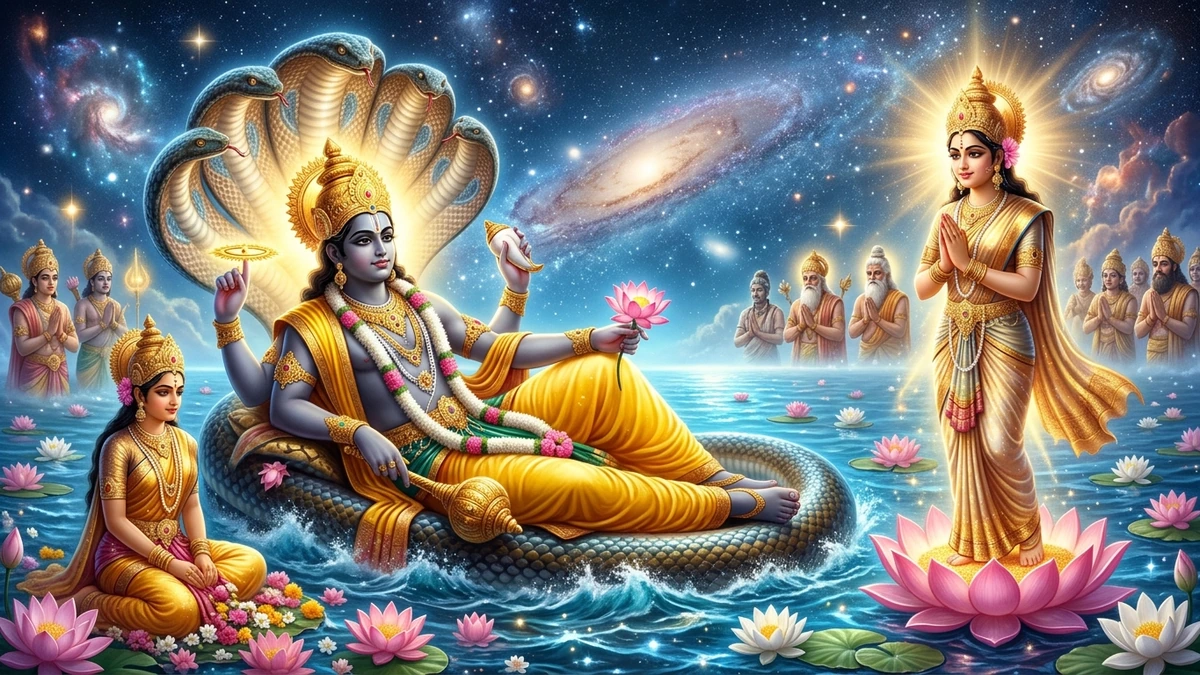
Meaning: The one who rests on the thousand-headed serpent Shesha in the Ocean of Milk.
Meaning: The Lord and master of all the gods in heaven.
Meaning: The one upon whose will the entire universe rests without any other support.
Meaning: The one who is infinite, pure, and omnipresent like the sky.
Meaning: The one whose dark complexion is as enchanting as rain-bearing clouds.
Meaning: The one whose entire form is extremely auspicious, beautiful, and beneficial.
Meaning: The beloved husband of Mother Lakshmi, the goddess of wealth and fortune.
Meaning: The one with large, beautiful eyes resembling lotus petals.
Meaning: The one who is realized through meditation in the hearts of great yogis.
Meaning: The one and only supreme Lord of all three worlds and the entire universe.
Meaning: The one who liberates souls from worldly bonds and grants salvation.
Meaning: The protector of cows, the Vedas, the earth, and the senses, who brings supreme joy.
Meaning: The protector of cows and the guardian of the entire earth.
Meaning: The valiant Lord who took the Narasimha (man-lion) form to protect devotee Prahlada.
Meaning: The one who rescued the earth from the depths of the ocean in his Varaha (boar) avatar.
Meaning: The Matsya (fish) avatar who saved the Vedas and sages during the great deluge.
Meaning: The Kurma (tortoise) avatar who supported Mount Mandara on his back during the churning of the ocean.
Meaning: The young Vamana who restored Indra's kingdom and blessed King Bali.
Meaning: The Bhargava Rama who rid the earth of tyrannical kings 21 times.
Meaning: The ideal man (Maryada Purushottam), slayer of Ravana, and embodiment of truth and Dharma.
Meaning: The one who draws all living beings to himself with his divine attraction.
Meaning: The peaceful form who taught non-violence, compassion, and supreme self-knowledge.
Meaning: The future avatar who will destroy unrighteousness at the end of Kali Yuga to establish Satya Yuga.
Meaning: The Lord in the form of the self-manifested stone found in the Gandaki River.
Meaning: The one who removes all the sins and sufferings of devotees just by being remembered.
Meaning: The one in whose body the entire universe, planets, stars, and beings reside.
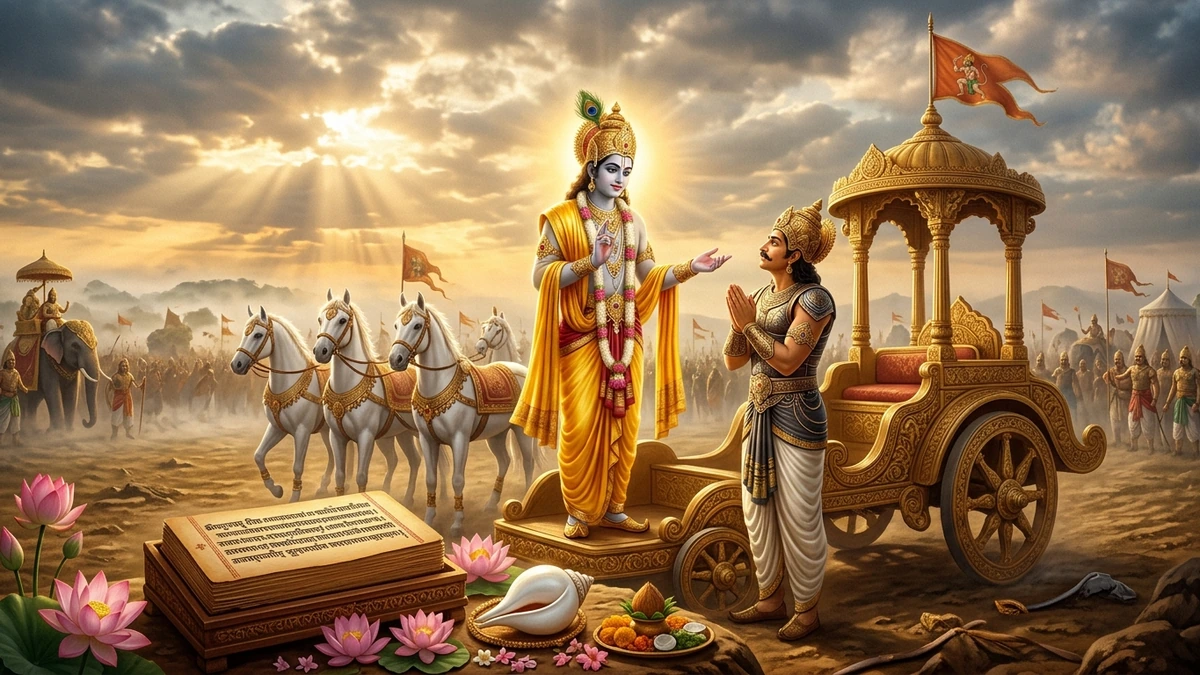
Meaning: The infinite cosmic form revealed to Arjuna during the Mahabharata war.
Meaning: The omniscient one who possesses complete knowledge of the past, present, and future.
Meaning: The one whose faces, eyes, and vision are present in all directions simultaneously.
Meaning: The one whose every resolve is an undeniable truth and manifests instantly.
Meaning: The protector of truth who always guards truthful devotees.
Meaning: The supreme Lord who empowers Kubera and all sources of wealth.
Meaning: The one whose praise and hymns purify the soul.
Meaning: The one from whose holy feet Mother Ganga, the purifier of sins, emerged.
Meaning: The one who is constantly praised by sages like Sanaka, Narada, and the Saptarishis.
Meaning: The primordial teacher of all yogic sciences, breath control, and meditation.
Meaning: The one who enters Yoga Nidra during the four months (Chaturmas) to internally regulate the universe.
Meaning: The one who awakens on Devutthana Ekadashi to initiate auspicious works in the world.
Meaning: The one to whom Tulsi leaves and manjaris are dearer than all jewels.
Meaning: The one who showers the nectar of love in the groves of Vrindavan.
Meaning: The one whose sweet flute melody enchants the entire creation.
Meaning: The one whose flow and power cannot be stopped by any force.
Meaning: The Lord who is the avatar of Kamadeva and endowed with infinite brilliance.
Meaning: The one who draws the entire universe into himself during the time of dissolution.
Meaning: The supreme person who is beyond both the perishable and imperishable natures.
Meaning: The King of the sacred Vaikuntha realm, which is free from sorrow, delusion, and fear.
Meaning: The one who rests on the calm waves of the nectar-like Ocean of Milk.
Meaning: The one who has countless forms, colors, avatars, and divine pastimes.
Meaning: The one who took the Mohini form to feed the gods the nectar of immortality.
Meaning: The one who immediately rescued the elephant king Gajendra from the clutches of the crocodile.
Meaning: The one who protected Draupadi's honor in the Kaurava court by extending her garment.
Meaning: The one who cuts through any crisis facing Dharma and his devotees in an instant.
Meaning: The one who grants fearlessness to anyone who seeks his refuge even once.
Meaning: The one who is known through pure self-knowledge and Sankhya Yoga.
Meaning: The one who is pleased not by difficult penance, but by love and selfless devotion.
Meaning: The holy Lord who burns away the sins accumulated over millions of lifetimes.
Meaning: The one who alleviates all three types of suffering: physical, divine, and material.
Meaning: The one who takes the form of Dhanvantari to grant the nectar of health.
Meaning: The one who protects the seeker from untimely death and grants a long, healthy life.
Meaning: The one who grants the blessing of virtuous progeny and family prosperity.
Meaning: The one who establishes honor, fame, and reputation in society.
Meaning: The one whose very remembrance turns all inauspiciousness into auspiciousness.
Meaning: The one who ensures the smooth completion of marriages, housewarmings, and auspicious ceremonies.
Meaning: The one who grants eternal liberation from the cycle of birth and death.
Meaning: The infinite ocean of Truth, Consciousness, and eternal Bliss.
Meaning: The one and only supreme reality described by all the Upanishads.
Meaning: The source of all individual souls and the supreme pure consciousness.
Meaning: The one who is greater than the greatest and the foundation of supreme power.
Meaning: The one who sustains every living being, from the smallest ant to the largest elephant.
Meaning: The one who removes all the sorrows, poverty, and ignorance of his devotees.
Meaning: The one whose first abode is water and who is the final refuge of all living beings.
Vishnu Gayatri Mantra and Stotra Recitation
After reciting the 108 names during daily worship, one should chant the Vishnu Gayatri Mantra at least 11 times. This mantra purifies the intellect and enhances decision-making ability:
॥ Om Narayanaya Vidmahe Vasudevaya Dhimahi. Tanno Vishnu Prachodayat ॥
Meaning of the Mantra: "We know the supreme person Narayana, we meditate upon Vasudeva. May Lord Vishnu inspire our intellect toward the righteous path."
5 Scriptural Rules for Daily Chanting and Worship
Frequently Asked Questions (FAQs)
Q1: What is the best time of day to recite the 108 names of Lord Vishnu?
Answer: It is best to recite them during the Brahma Muhurta (before sunrise) or immediately after bathing in the morning while wearing yellow clothes. If you cannot find time in the morning, you may also recite them during the evening twilight (Godhuli Vela) after lighting a lamp.
Q2: Can women also chant the 'Om Namo Bhagavate Vasudevaya' mantra?
Answer: Yes, absolutely. This Vedic and Puranic Mahamantra is equally beneficial for all men and women. Any person, regardless of caste, age, or status, can chant this mantra with a pure heart.
Q3: Which rosary (mala) is most auspicious for chanting Vishnu mantras?
Answer: A Tulsi mala is considered the best for chanting Lord Vishnu's names. Mother Tulsi is very dear to Shri Hari, so chanting with a Tulsi mala provides infinite merit. A sandalwood mala is also a suitable alternative.
Q4: Can the Vishnu Namavali be recited without formal initiation (Diksha)?
Answer: Yes, there is no mandatory requirement for formal Guru Diksha for chanting the names of the Lord. In this Kali Yuga, any name of the Lord taken with faith and love is always fruitful.
Q5: Does reciting this 108 Namavali give the same merit as the Vishnu Sahasranama?
Answer: According to the scriptures, for those who do not have the time to recite the entire Sahasranama (1,000 verses) daily, these 108 names are considered the essence of the entire Sahasranama. Reciting this even once with devotion yields merit equivalent to the Sahasranama.